
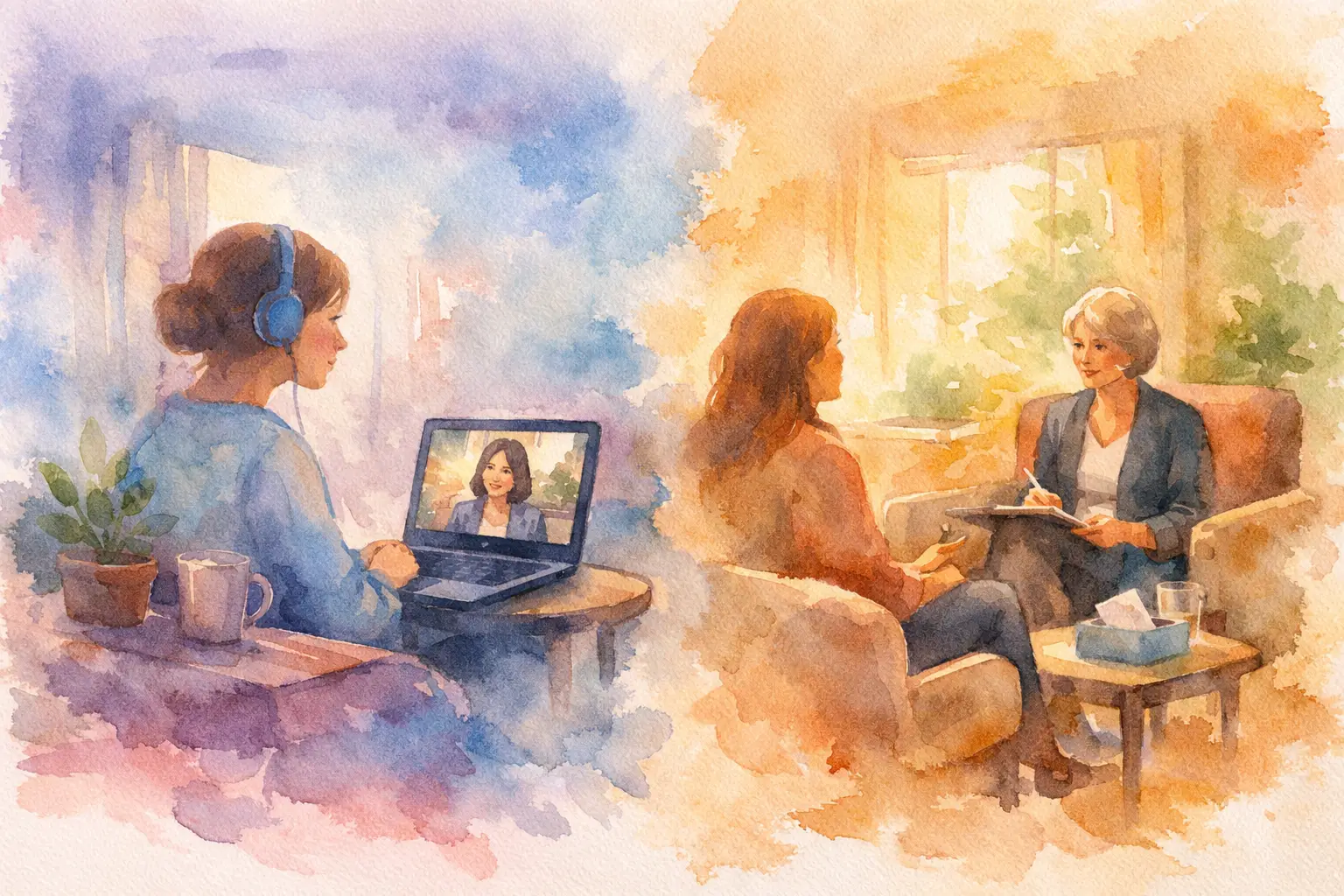
You may already know you want therapy, but still feel stuck on one practical question: online therapy vs in person. For many people, this is not a small detail. It can shape how safe you feel, how easy it is to attend, and how likely you are to keep going when life becomes busy or difficult.
The good news is that there is no single right answer. Both formats can be effective. What matters most is finding an approach that supports honest conversation, regular attendance, and a sense of trust with your therapist. For one person, that may be a quiet therapy room away from home. For another, it may be speaking from their own sofa without the pressure of travelling.
Online therapy vs in person: what really changes?
At heart, therapy is still therapy. Whether you meet in a counselling room or through a secure video call, the work often centres on the same things: understanding patterns, making sense of emotions, processing difficult experiences, and finding healthier ways forward.
What changes is the setting. That setting can affect how open you feel, how your body responds, and how easy it is to make sessions part of everyday life.
In-person therapy offers a dedicated space that is separate from home, work, and family demands. Many people find that physically arriving somewhere helps them shift mentally too. It creates a boundary around the session. You are there for one purpose, and that can make it easier to focus.
Online therapy offers flexibility that can remove genuine barriers. If you have a demanding job, caring responsibilities, mobility issues, anxiety about travel, or limited time, remote sessions may make support much more realistic. Sometimes the best format is simply the one you can attend consistently.
When in-person therapy may feel more supportive
There are times when face-to-face work feels especially helpful. If you struggle to find privacy at home, an in-person session can provide a calm, confidential setting where you do not have to worry about being overheard. That alone can make a real difference.
Some clients also find that being physically present with a therapist helps them feel more connected. Small details such as body language, the atmosphere in the room, and the sense of being accompanied can make hard conversations feel more manageable.
This can be particularly valuable if you are dealing with trauma, grief, high anxiety, or relationship difficulties that leave you feeling emotionally exposed. It does not mean online work cannot help in these areas, because it often does. But some people feel steadier when they are not carrying the whole session from their own home environment.
In-person sessions may also suit people who spend too much of their day on screens already. If your work is digital and draining, another video call can feel like one demand too many. Sitting with someone in a quiet room may feel more human, more grounded, and less tiring.
When online therapy may be the better option
Online therapy is not a second-best version of support. For many people, it is the reason therapy becomes possible at all.
If you are balancing work, childcare, health issues, or a packed schedule, online sessions can save enough time and energy to make regular therapy sustainable. You do not need to factor in travel, parking, or rushing across town. That matters more than people sometimes realise.
For some clients, being at home also makes it easier to open up. A familiar environment can reduce the stress of meeting in a new place. If social anxiety, panic, or low mood make leaving the house feel overwhelming, online therapy can offer a gentler starting point.
Remote sessions can be especially helpful for people across Folkestone, Hythe and the wider Kent area who want access to private support without adding another logistical strain to the week. In that sense, convenience is not a luxury. It can be part of what protects continuity of care.
There is also a privacy benefit that some people value. Attending online can feel discreet. You do not need to arrive at a clinic or explain where you are going. For those who are anxious about being recognised or judged, that can lower the threshold to seeking help.
The question most people are really asking
When people compare online therapy vs in person, they are often asking something deeper: where will I feel safest enough to be honest?
That question matters because therapy works best when you can speak openly, even if you start slowly. Safety is not only about confidentiality. It is also about emotional safety. Can you cry without feeling self-conscious? Can you sit with silence? Can you talk about shame, anger, grief, or trauma without wanting to shut down?
For one person, safety comes from being in a professional room with no distractions. For another, it comes from having a cup of tea nearby, a blanket on the sofa, and the reassurance of being in their own space afterwards.
Neither response is wrong. Therapy is personal, and the format should support you rather than force you into a way of working that does not fit.
Practical differences that matter more than you think
A lot of the choice comes down to everyday realities rather than theory. If your internet connection is unreliable, online sessions may become frustrating. If your home is busy and privacy is limited, you may find yourself holding back.
Likewise, if travelling to appointments adds stress, cost, or exhaustion, face-to-face therapy can become harder to maintain over time. A format that feels ideal in principle is not always ideal in practice.
Energy levels matter too. Some people feel more present and engaged in person. Others find travelling before and after a session leaves them depleted, especially when discussing painful experiences. Online sessions can make it easier to rest immediately afterwards, which may be important if the work is emotionally demanding.
The right choice often comes from asking simple questions. Where can I talk freely? What will make regular attendance realistic? When am I most likely to stay with the process, even on difficult weeks?
Is one more effective than the other?
For many issues, both online and in-person therapy can be effective when the relationship with the therapist is strong and the sessions are consistent. Anxiety, depression, stress, bereavement, low self-esteem, and relationship difficulties can all be explored well in either format.
What matters is not just the method, but the fit. A skilled therapist will pay attention to how you respond, how safe you feel, and whether the current setup is helping you engage fully.
There are, however, times when one format may be preferable. Certain forms of trauma work, including some specialist approaches, may benefit from face-to-face sessions depending on the client, the severity of symptoms, and the type of intervention. Equally, some trauma survivors feel more in control online because they are in familiar surroundings. It really does depend.
If you are seeking couples counselling, both options can work, but practical and emotional dynamics matter. Some couples communicate better in a neutral room. Others appreciate the ease of joining remotely around work and family life. The usefulness of the format often becomes clear quite quickly once sessions begin.
You do not have to get it perfect at the start
One of the biggest worries people have is choosing the wrong option. In reality, therapy can be flexible. You may begin online and later decide you would prefer face-to-face support. Or you might start in person, then switch to remote sessions when work, health, or family demands change.
That flexibility can be reassuring. The goal is not to make a perfect decision before you begin. The goal is to start in a way that feels possible and supportive.
At Self Horizons, this is often how people arrive at the best fit for them. They do not need a textbook answer. They need therapy that works in real life, with the right balance of professionalism, accessibility, and emotional safety.
How to decide which format suits you
If you are unsure, try thinking less about which format sounds better and more about how you are most likely to engage honestly. Notice what happens in your body when you imagine each option. Does one feel calmer, easier, or more manageable? Does one bring a sense of relief?
It can also help to think about what has stopped you seeking support before. If the obstacle has been time, travel, or fitting sessions around other responsibilities, online therapy may remove enough friction to help you begin. If the obstacle has been difficulty opening up at home or feeling distracted in familiar surroundings, in-person work may offer the structure you need.
Sometimes the clearest sign is very simple: the best therapy format is often the one you can keep turning up for.
If you are ready for support, it is worth remembering that choosing between online and in-person therapy is not a test. It is simply part of finding care that meets you where you are, and helps you move forward with a little more steadiness than before.